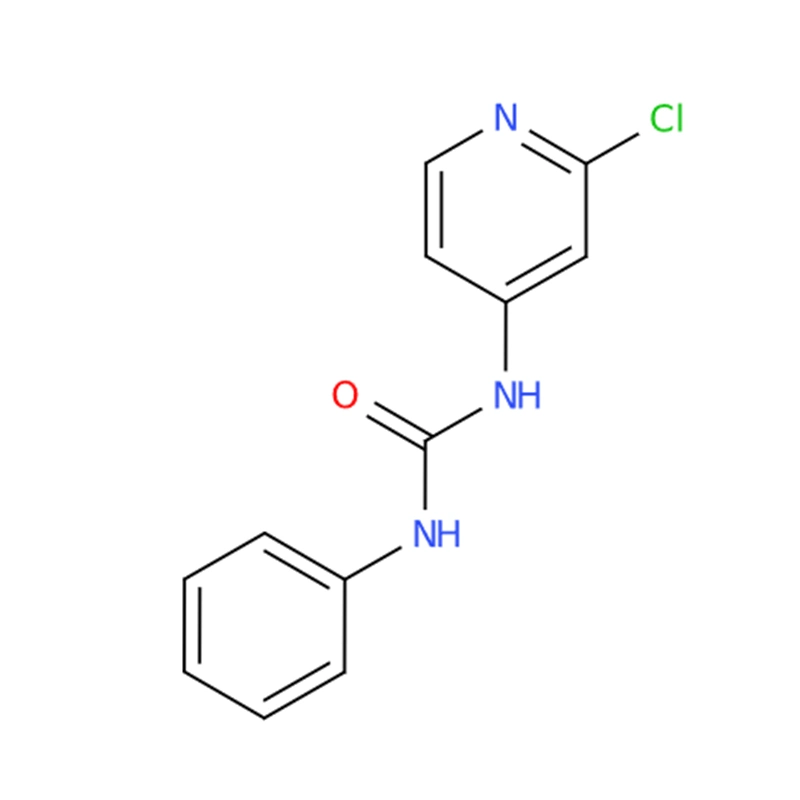
Product Description of Forchlorfenuron CAS#68157-60-8
With the alternative titles CPPU and KT-30, forchlorfenuron belongs to cytokinin-class plant-growth regulators, whose chemical name is 1-(2-chloropyridin-4-yl)-3-phenylurea. This substance helps plant tissue generate callus tissue and boosts the budding growth before crop picking. For harvested fruits and vegetables, it delivers excellent effects on retarding leaf chlorosis and cutting down post-harvest plant disease incidence. As typical practical cases, it can efficiently slow-down the yellow-leaf progression of rice and Chinese cabbage foliage.
Forchlorfenuron Chemical Properties
| Melting point | 170-172°C |
| Boiling point | 308.4±27.0 °C(Predicted) |
| density | 1.415±0.06 g/cm3(Predicted) |
| storage temp. | Inert atmosphere,2-8°C |
| solubility | Soluble in DMSO or Ethanol |
| form | Solid |
| pka | 12.55±0.70(Predicted) |
| color | White or off-white |
| Stability: | Stable for 1 year from date ofpurchase as supplied. Solutions in DMSO or ethanol may be stored at -20°C for up to 3 months. |
| InChIKey | GPXLRLUVLMHHIK-UHFFFAOYSA-N |
| CAS DataBase Reference | 68157-60-8(CAS DataBase Reference) |
| EPA Substance Registry System | Forchlorfenuron (68157-60-8) |
| Hazard Codes | Xi,N,Xn |
| Risk Statements | 36/37-51/53-40 |
| Safety Statements | 26-36-61-46-36/37 |
| RIDADR | UN3077 9/PG 3 |
| WGK Germany | 3 |
| RTECS | YS7182500 |
| HazardClass | 9 |
| PackingGroup | III |
| HS Code | 29333990 |
| Hazardous Substances Data | 68157-60-8(Hazardous Substances Data) |
| Toxicity | LD50 oral in mouse: > 500mg/kg |

Product Application of Forchlorfenuron CAS#68157-60-8
Classified as phenylurea-type cytokinin, forchlorfenuron takes charge of bud growth regulation, accelerates cell division and facilitates cell expansion as well as differentiation. It can lessen blossom and fruit shedding, boost plant development, speed-up ripening, slow late-season leaf ageing and raise crop production.
Its primary practical-use fields are listed below. First, it fuels the development of roots, stalks, foliage and fruits, and expands tobacco leaf dimension and output. Second, it improves fruit-setting rate for tomato, aubergine and apple. Third, it adjusts fruit thinning and leaf fall to obtain evenly-sized, high-quality fruits and simplify harvesting of cotton and soybean. High-dose solutions may serve as weed-control agent. Besides, it assists cotton leaf-shedding and lifts the sugar concentration of sugar-beet and sugarcane.