Product Description of Tetrahydrothiophene CAS#110-01-0
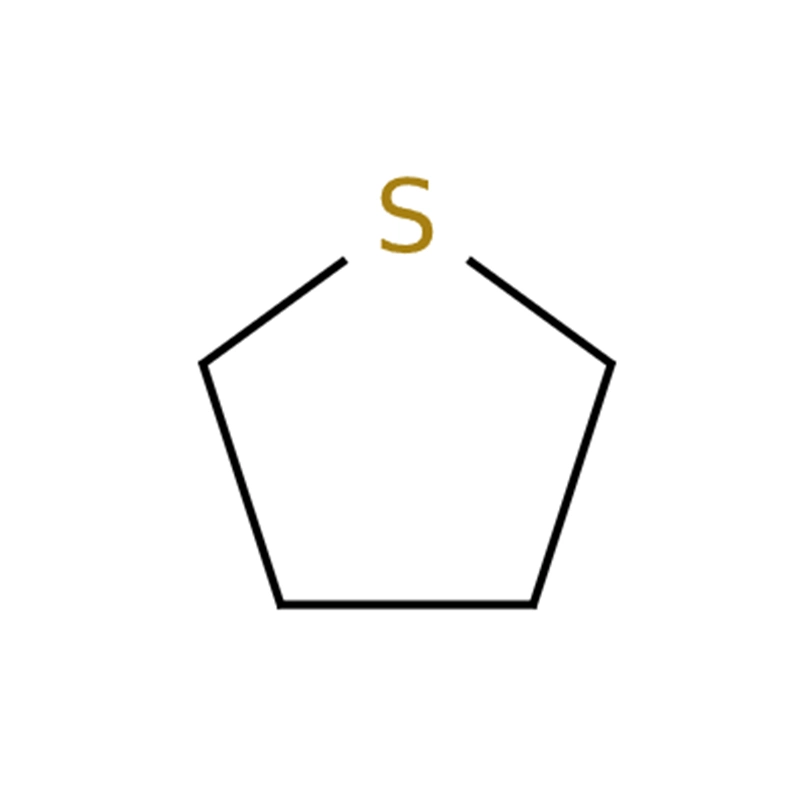
Tetrahydrothiophene (THT), alternatively named thiolane, tetramethylene sulfide or butylene sulfide, is a saturated sulfur-containing heterocyclic compound. It is synthesized via the catalytic hydrogenation of thiophene. This hydrogenation reaction eliminates the conjugated structure and aromatic characteristics of thiophene, enabling THT to present typical sulfide chemical properties. Accordingly, it is susceptible to oxidation to generate sulfoxide and sulfone derivatives, including cyclopentane sulfone.
THT is a colorless, clear and volatile liquid. It is immiscible with water yet fully compatible with common organic solvents including ethanol, ether, benzene and acetone. The chemical features a strong, unique and highly stable odor that lingers persistently. Its olfactory threshold in air is as low as 0.01 ppm, making it trace-detectable.
Thanks to its stable odor profile, non-corrosive property toward gas facilities and pipeline sealing components, as well as its inability to cause olfactory fatigue, THT serves as a premium warning odorant for natural gas and urban fuel gas. It is widely dosed in small amounts as an ideal substitute for conventional odorants like ethyl mercaptan.
Tetrahydrothiophene Chemical Properties
| Melting point | -96 °C (lit.) |
| Boiling point | 119 °C (lit.) |
| density | 1 g/mL at 25 °C (lit.) |
| vapor pressure | 18 mm Hg ( 25 °C) |
| refractive index | n20/D 1.504(lit.) |
| Fp | 55 °F |
| storage temp. | Store below +30°C. |
| solubility | immiscible |
| form | liquid |
| Specific Gravity | 1.002 (20/4℃) |
| color | Colorless to Almost colorless |
| Odor | Smells of rotting eggs |
| PH | 7 (H2O, 20℃) |
| explosive limit | 1.1-12.1%(V) |
| Odor Threshold | 0.00062ppm |
| Odor Type | sulfurous |
| Water Solubility | immiscible |
| Merck | 149218 |
| BRN | 102392 |
| Dielectric constant | 8.61 |
| Stability: | Highly flammable. Vapour-air mixtures explosive in some proportions; note low flash point and fairly wide explosion limit range. Heavier than air, so potentially explosive mixtures may travel considerable distances to source of ignition. |
| LogP | 1.8 at 20℃ |
| CAS DataBase Reference | 110-01-0(CAS DataBase Reference) |
| NIST Chemistry Reference | Thiophene, tetrahydro-(110-01-0) |
| EPA Substance Registry System | Tetrahydrothiophene (110-01-0) |
Safety Information
| Hazard Codes | F,Xn |
| Risk Statements | 11-20/21/22-36/38-52/53 |
| Safety Statements | 16-23-36/37-61 |
| RIDADR | UN 2412 3/PG 2 |
| WGK Germany | 2 |
| RTECS | XN0370000 |
| Autoignition Temperature | 202 °C |
| TSCA | Yes |
| HazardClass | 3 |
| PackingGroup | II |
| HS Code | 29349990 |
| Hazardous Substances Data | 110-01-0(Hazardous Substances Data) |
| Toxicity | LD50 by inhalation in mice: 26.7 mg/l (Carlucci) |

Product Application of Tetrahydrothiophene CAS#110-01-0
Tetrahydrothiophene is extensively applied as a gas odorant for multiple fuel gas types, covering urban pipeline gas, liquefied petroleum gas (LPG) and liquefied natural gas (LNG). Its addition enables effective gas leakage alerting, ensuring safe gas usage with dependable early warning effects. Apart from its mainstream gas odorization application, this compound acts as a crucial industrial precursor. It is widely adopted for the manufacturing of pharmaceutical products, agrochemical pesticides, and a variety of customized compounds in organic synthesis processes.