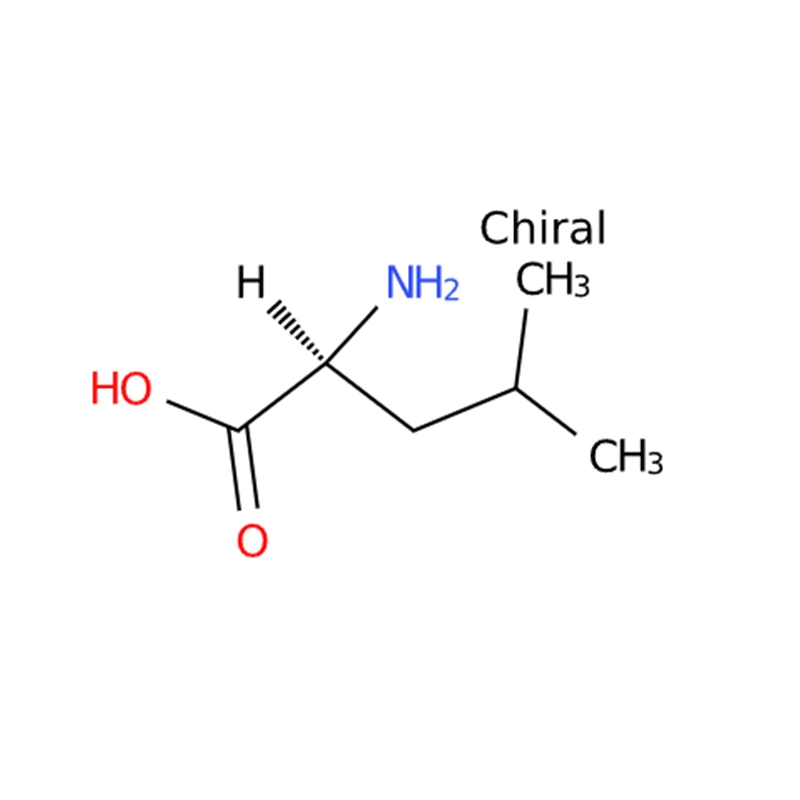
Product Description of L-Leucine CAS#61-90-5
Classified as an indispensable amino-acid, L-Leucine ranks among the twenty-standard protein-building amino acids. Falling under aliphatic amino-acid category, it combines with L-isoleucine and L-valine to constitute branched-chain amino acids (BCAAs). This substance represents the optical isomer of D-leucine. The commercial-grade goods appear as white crystalline powder or shiny hexagonal crystals. It carries no peculiar smell and delivers a mildly bitter flavour.
L-Leucine Chemical Properties
| Melting point | >300 °C (lit.) |
| alpha | 15.4 º (c=4, 6N HCl) |
| Boiling point | 122-134 °C(Press: 2-3 Torr) |
| bulk density | 300-400kg/m3 |
| density | 1,293 g/cm3 |
| vapor pressure | <1 hPa (20 °C) |
| refractive index | 1.4630 (estimate) |
| FEMA | 3297 | L-LEUCINE |
| Fp | 145-148°C |
| storage temp. | 2-8°C |
| solubility | 1 M HCl: 50 mg/mL |
| form | powder |
| pka | 2.328(at 25℃) |
| color | White to Off-white |
| Odor | at 100.00?%. odorless |
| PH | 5.5-6.5 (20g/l, H2O, 20℃) |
| biological source | plant |
| Optical Rotation | [α]20/D +15.5°, c = 2 in 6 M HCl |
| Water Solubility | 22.4 g/L (20 C) |
| λmax | λ: 260 nm Amax: 0.05 |
| λ: 280 nm Amax: 0.05 | |
| JECFA Number | 1423 |
| Sublimation | 145-148 ºC |
| Merck | 145451 |
| BRN | 1721722 |
| Stability: | Stability Moisture and light sensitive. Incompatible with strong oxidising agents. |
| LogP | 0.8 |
| CAS DataBase Reference | 61-90-5(CAS DataBase Reference) |
| NIST Chemistry Reference | Leucine(61-90-5) |
| EPA Substance Registry System | L-Leucine (61-90-5) |
| Safety Statements | 24/25 |
| WGK Germany | 3 |
| RTECS | OH2850000 |
| TSCA | Yes |
| HS Code | 29224995 |
| Hazardous Substances Data | 61-90-5(Hazardous Substances Data) |

Product Applications of L-Leucine CAS#61-90-5
L-Leucine serves as a crucial nutritional amino acid widely applied in food, pharmaceutical and feed industries.
In food processing, it acts as a common nutritional fortifier and flavor modifier to optimize the taste of baked goods and grain products while supplementing essential human nutrients.
In the pharmaceutical field, this branched-chain amino acid is a key raw material for compound amino acid injections and oral nutritional preparations. It supports human protein metabolism, promotes muscle tissue repair and assists normal physiological metabolism.
Additionally, it is extensively adopted as a high-efficiency feed additive for livestock and poultry breeding. It effectively boosts animal growth performance, improves nutrient utilization efficiency and enhances overall breeding benefits. It can also be used as a biological reagent for daily biochemical research and experimental analysis.