
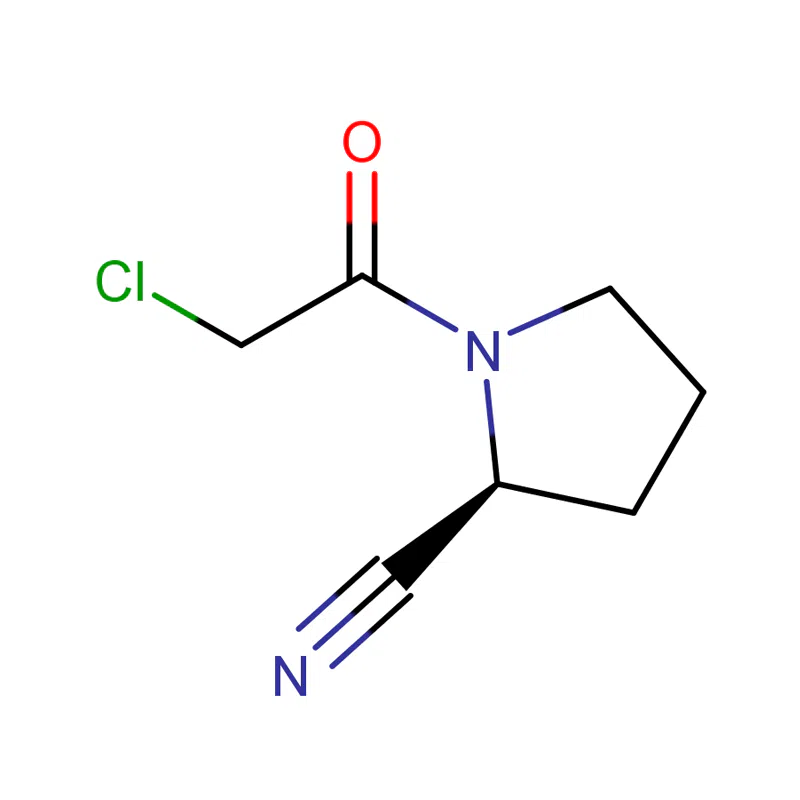
Product Description of (2S)-1-(Chloroacetyl)-2-pyrrolidinecarbonitrile CAS#207557-35-5
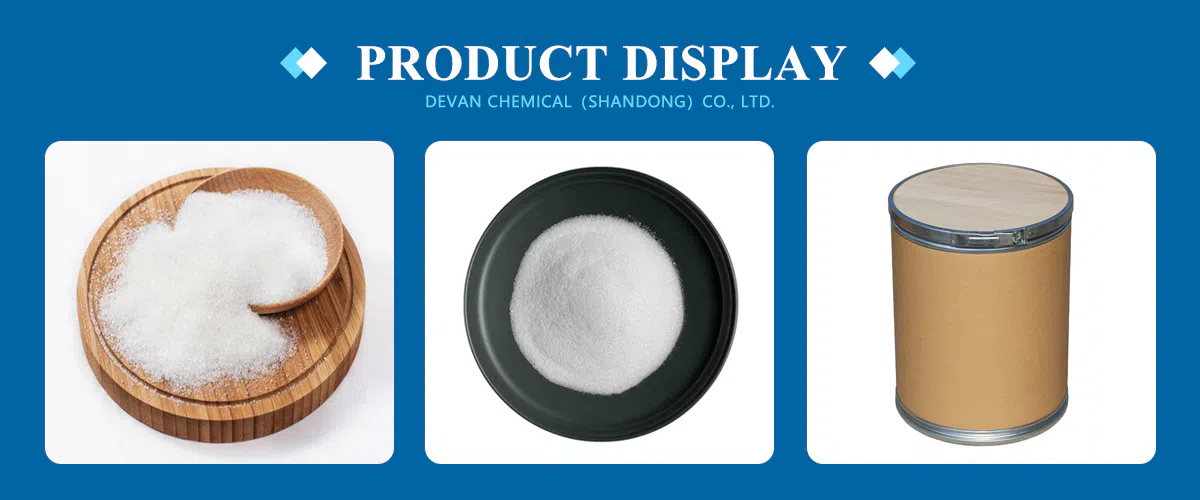
(2S)-1-(Chloroacetyl)-2-pyrrolidinecarbonitrile has molecular formula C7H9ClN2O and molecular weight of 172.61. It is a white to pale yellow crystalline solid with a melting point of 52–53°C. This chiral compound contains cyano and chloroacetyl functional groups, delivering good reactivity for nucleophilic substitution reactions.
The product is sensitive to moisture and heat, and requires sealed storage under inert gas at 2–8°C to avoid degradation. It is a key chiral pharmaceutical intermediate mainly applied for the synthesis of Vildagliptin, a DPP-4 inhibitor anti-diabetic drug.
(2S)-1-(Chloroacetyl)-2-pyrrolidinecarbonitrile Chemical Properties
| Melting point | 52-53 °C |
| Boiling point | 363.1±37.0 °C(Predicted) |
| density | 1.27±0.1 g/cm3(Predicted) |
| storage temp. | under inert gas (nitrogen or Argon) at 2-8°C |
| solubility | Chloroform (Slightly), DMSO (Slightly), Methanol (Slightly) |
| form | Solid |
| pka | -4.65±0.40(Predicted) |
| color | White to Pale Yellow to Light Brown |
| Stability: | Hygroscopic |
| HS Code | 2933998090 |
Product Application of (2S)-1-(Chloroacetyl)-2-pyrrolidinecarbonitrile CAS#207557-35-5
(2S)-1-(Chloroacetyl)-2-pyrrolidinecarbonitrile, which is also referred to as (2S)-N-chloroacetyl-2-cyanotetrahydropyrrole, acts as a core synthetic intermediate for Vildagliptin, and it is chiefly applied to generate this pharmaceutical molecule.
Within the synthetic route, L-prolinamide is adopted as the starting raw material. Chloroacetylation reaction proceeds in THF solvent with K₂CO₃ functioning as acid-binding reagent to yield (S)-1-(2-chloroacetyl)-2-pyrrolidine carboxamide. Afterwards, the amide functional group transforms into nitrile group via dehydration-cyanation treatment with TFAA, delivering the target intermediate (2S)-N-chloroacetyl-2-cyanotetrahydropyrrole.
Following that, taking DCM as solvent and K₂CO₃ as acid-binding agent, this intermediate carries out condensation reaction together with 3-amino-1-adamantanol. Vildagliptin can be acquired after column-chromatography purification steps.