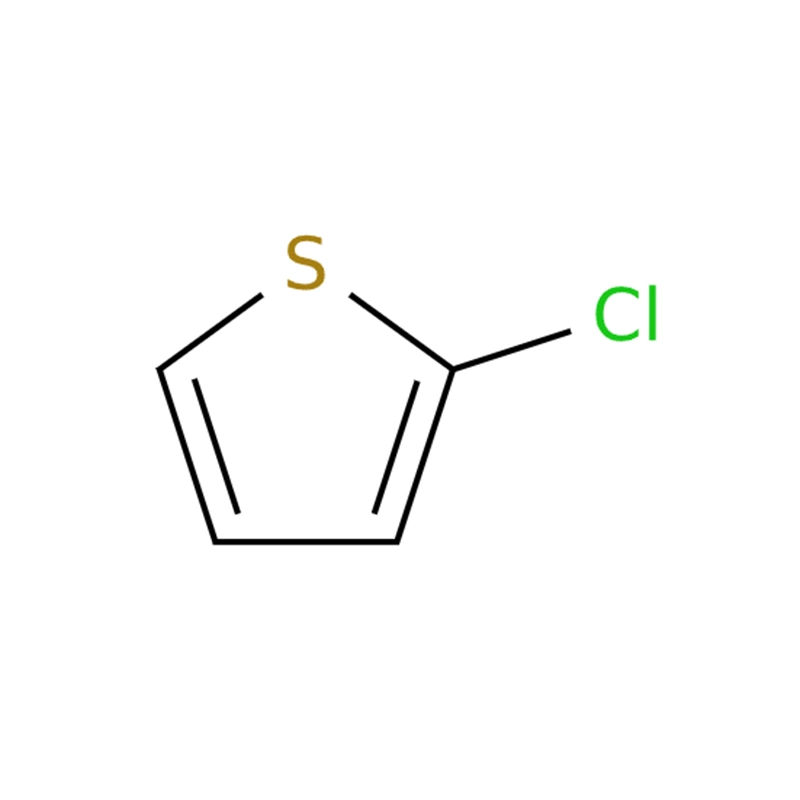
Products Description of 2-Chlorothiophene CAS#96-43-5
2-Chlorothiophene belongs to the family of chlorine-substituted heterocyclic chemicals. Its molecular formula is C4H3ClS and the molecular-weight parameter equals 118.585. The chemical manifests as colorless to light brown transparent liquid under ambient surroundings.
Its physical indexes cover the 1.285 g/cm³ density measured at 20℃, a boiling-point range of 128-129℃, -72℃ melting point and 22℃ flash-point. The substituted thiophene framework brings good reaction activity. This raw-material mainly acts as a pharmaceutical synthetic building-block for manufacturing multiple medicine molecules carrying thiophene cyclic structures.

2-Chlorothiophene CAS#96-43-5 Chemical Properties
| Melting point | -71.9 °C |
| Boiling point | 127-129 °C (lit.) |
| density | 1.286 g/mL at 25 °C (lit.) |
| refractive index | n20/D 1.547(lit.) |
| Fp | 73 °F |
| storage temp. | 2-8°C |
| solubility | soluble in Chloroform |
| form | Liquid |
| Specific Gravity | 1.286 |
| color | Clear colorless to light brown |
| Water Solubility | INSOLUBLE |
| BRN | 104652 |
| Stability: | Volatile |
| InChIKey | GSFNQBFZFXUTBN-UHFFFAOYSA-N |
| CAS DataBase Reference | 96-43-5(CAS DataBase Reference) |
| NIST Chemistry Reference | Thiophene, 2-chloro-(96-43-5) |
| EPA Substance Registry System | Thiophene, 2-chloro- (96-43-5) |
| Hazard Codes | Xi,F,T |
| Risk Statements | 10-36/37/38-23/24/25-37 |
| Safety Statements | 16-26-36-45-38-36/37/39-28B-7/9 |
| RIDADR | UN 1993 3/PG 3 |
| WGK Germany | 3 |
| RTECS | XM8575000 |
| Hazard Note | Irritant |
| TSCA | T |
| HazardClass | 3 |
| PackingGroup | II |
| HS Code | 29349990 |

Product Application of 2-Chlorothiophene CAS#96-43-5
With its chemically-active chlorine substituent on the five-membered heterocycle, 2-chlorothiophene works as a versatile building block for diverse organic modification reactions. It serves as a core precursor during the fabrication of thiophene-ring-containing pharmaceutical raw materials.
Beyond medicinal-chemistry production, this substance can also be adopted to synthesize fine-chemical additives and research-oriented heterocyclic derivatives. Chemists carry out substitution reactions on its chlorine site so as to develop brand-new bioactive molecules for laboratory screening of drug candidates.