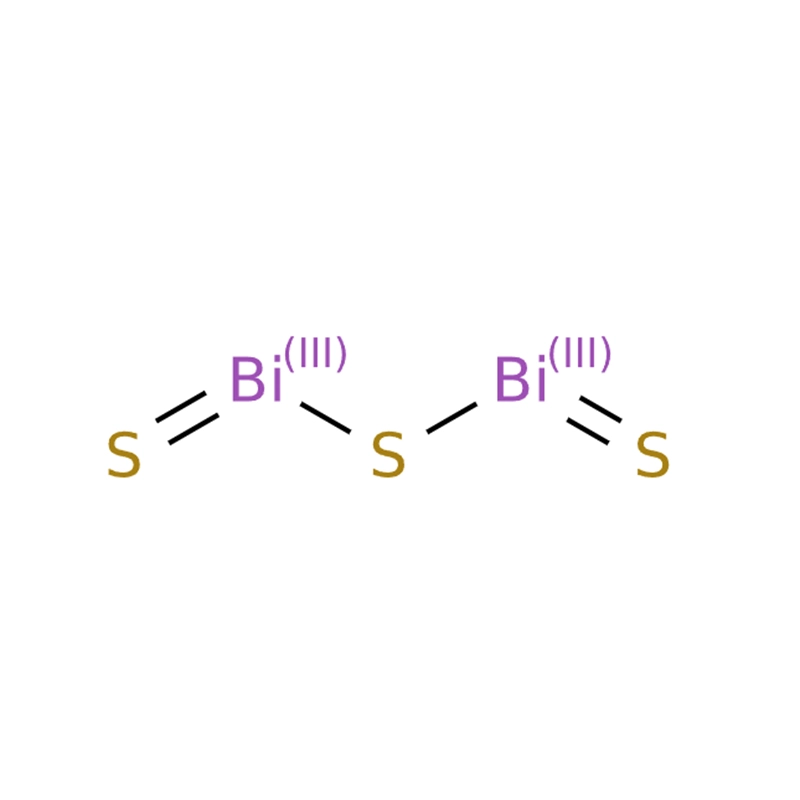
Products Description of Bismuth Sulfide CAS#1345-07-9
Bismuth Sulfide is an inorganic bismuth compound existing as a black or brownish-black crystalline powder or blocky solid with the chemical formula Bi₂S₃. It is insoluble in water and dilute non-oxidizing acids, and can dissolve in concentrated strong acids. It has good chemical stability at room temperature and exhibits semiconductor characteristics.
This product is produced under controlled processes to achieve consistent particle size and low impurity content. It is widely used as a raw material for bismuth metal smelting, a precursor for preparing bismuth-based functional materials, and for research in optoelectronic and thermoelectric fields.

Bismuth Sulfide Chemical Properties
| Melting point | 685°C (dec.) |
| density | 7.7 g/mL at 25 °C(lit.) |
| solubility | insoluble in H2O; soluble in acid solutions |
| form | Solid |
| Specific Gravity | 7.7 |
| color | Grey to black |
| Water Solubility | Insoluble in water. Soluble in acids. |
| Merck | 131288 |
| Solubility Product Constant (Ksp) | pKsp: 97 |
| CAS DataBase Reference | 1345-07-9(CAS DataBase Reference) |
| EPA Substance Registry System | Bismuth sulfide (Bi2S3) (1345-07-9) |
| Hazard Codes | Xi |
| Risk Statements | 36/37/38 |
| Safety Statements | 26 |
| WGK Germany | 2 |
| RTECS | EB3105000 |
| TSCA | Yes |
| Toxicity | mouse,LD50,oral,10gm/kg (10000mg/kg),Gigiena Truda i Professional'nye Zabolevaniya. Labor Hygiene and Occupational Diseases. Vol. 30(6), Pg. 16, 1986. |

Product Application of Bismuth Sulfide CAS#1345-07-9
Bismuth sulfide is a significant semiconductor material with promising applications in thermoelectric components, electronics, optoelectronic devices and infrared spectroscopy. Possessing a band gap of 1.33 eV at ambient temperature, it can be utilized for manufacturing photoelectric converters and is extensively adopted in thermoelectric cooling systems.
Nanoscale bismuth sulfide displays blue shifts in its UV-visible absorption and fluorescence emission wavelengths. It also delivers nonlinear optical responses, and its nanoparticles feature intensified redox activity. Furthermore, it exhibits outstanding photoelectrocatalytic properties, which endows it extensive application potential in luminescent materials, nonlinear optical materials and photocatalytic systems.